A Dialectical Introduction
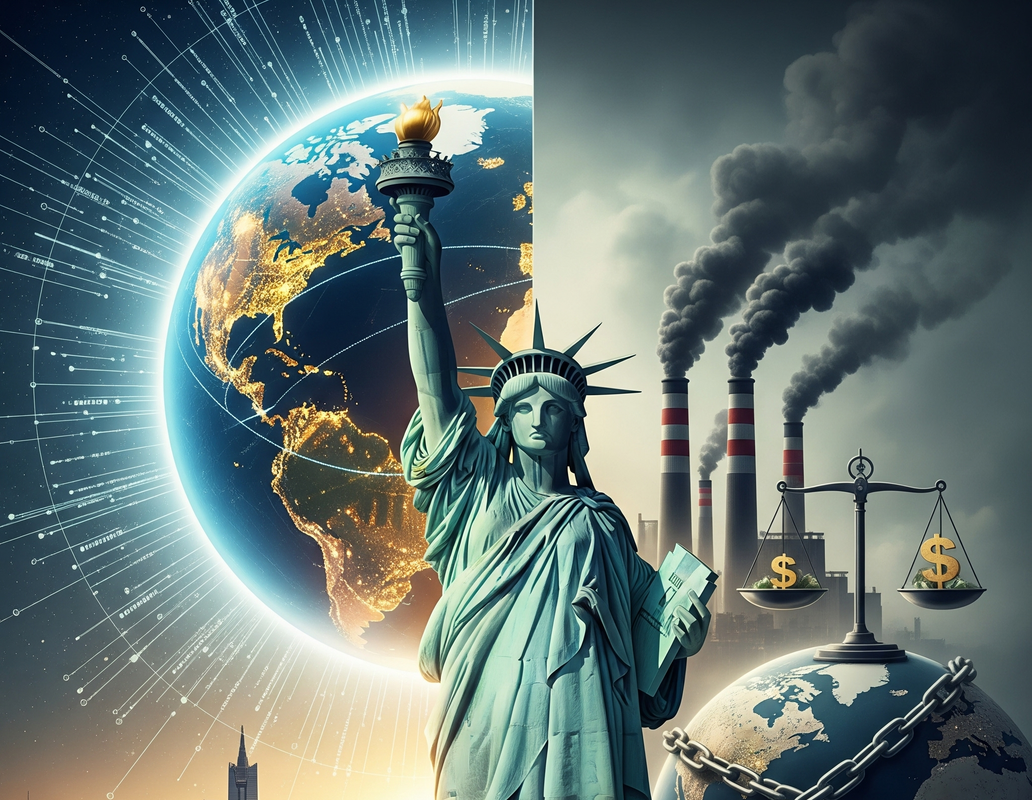
From an external viewpoint, the American project presents a fascinating paradox. It is a nation founded on explicit ideals of liberty, democracy, and individual sovereignty, yet its most profound global impact has been delivered not through philosophical treatise, but through the overwhelming, often impersonal, force of its economic and productive might. The narrative of the 20th and 21st centuries is inextricably linked to how the United States leveraged capitalism, not merely as an internal economic system, but as a dynamic, world-altering engine. This engine, fueled by immense productivity and technological innovation, simultaneously promoted a vision of a freer, more prosperous world while forging new and complex systems of dependency. To understand the current global landscape is to analyze the stages through which this economic power radiated outwards, shaping nations, markets, and the very fabric of society in a process that was less a deliberate conquest and more the inexorable consequence of a system built for expansion.
Phase I: The Architect of Order (c. 1945–1971)
The conclusion of the Second World War left the world fractured and its great powers, save one, in ruins. The United States emerged not just as a military victor, but as the sole industrial power with its infrastructure intact and its productive capacity supercharged. This unique position allowed it to transition from the "arsenal of democracy" to the architect of a new global economic order. From the outside, this phase was defined by two monumental initiatives: the Marshall Plan and the Bretton Woods system. The Marshall Plan was a masterstroke of economic statecraft. By injecting massive capital into Western Europe, the U.S. simultaneously rebuilt devastated economies and contained the ideological spread of communism. More importantly, it cultivated future markets for American goods, creating a transatlantic economic ecosystem dependent on American industrial output and consumption. Concurrently, the Bretton Woods Agreement established a global financial architecture with the U.S. dollar, pegged to gold, at its center. The creation of the International Monetary Fund (IMF) and the World Bank—largely funded and influenced by the U.S.—provided the mechanisms to stabilize this system. For nations outside the Soviet sphere, integration into this framework was the only viable path to reconstruction and growth. This stage was not about exporting democracy through ballots, but through blueprints and balance sheets.
Phase II: The Catalyst for Globalization (c. 1971–1989)
This era began with a seismic shock: the U.S. unilaterally dismantling the Bretton Woods system by decoupling the dollar from gold in 1971. While internally a response to domestic economic pressures, its external effect was to unmoor the global economy, ushering in an age of floating exchange rates and, critically, financialization. This period saw the rise of a new economic orthodoxy, often termed the "Washington Consensus." Through the influence of the IMF and World Bank, the American model of deregulation, privatization, and free trade was promoted globally as the universal prescription for economic development. From an outside-in perspective, this was the phase where American capitalism began to operate as a truly globalizing force. U.S.-based multinational corporations expanded aggressively, seeking efficiencies in labor and resources abroad. This catalyzed the creation of global supply chains, integrating economies across continents in a production process whose nerve center remained in the United States. The world was being rewired not by diplomats, but by a corporate and financial logic that prioritized efficiency and shareholder value.
Phase III: The Unipolar Vanguard of the Digital Age (c. 1989–2008)
The collapse of the Soviet Union left the United States as the world’s sole superpower. This "unipolar moment" saw the ideological triumph of liberal-democratic capitalism, with its American variant as the de facto standard. The key development of this era, however, was the commercialization and globalization of a technology born from U.S. military research: the internet. Externally, the U.S. became the vanguard of the digital revolution. Companies like Microsoft, Intel, Cisco, and later Google and Amazon, built the foundational layers of the new global economy. Silicon Valley, with its unique ecosystem of venture capital and disruptive innovation, became a global magnet for talent. This was not just about exporting products; it was about exporting a new paradigm of productivity. This technological dominance was a powerful amplifier of American soft power, as American software platforms, social media, and entertainment became globally ubiquitous, shaping cultural norms and consumer aspirations.
Phase IV: The Challenged Incumbent in a Multipolar System (c. 2008–Present)
The 2008 Global Financial Crisis marked a critical turning point. Originating from within the heart of the U.S. financial system, the crisis exposed deep vulnerabilities in the model of deregulated capitalism. For the first time, the credibility of the American-led economic order was severely damaged. This crisis accelerated a power shift that was already underway. The primary beneficiary was China, whose state-directed model of capitalism had allowed it to become the world's manufacturing workshop. It transitioned from a participant in the American-led system to a challenger, launching its own initiatives like the Belt and Road Initiative. In this current phase, the United States is a challenged incumbent. Its technological leadership is now contested. The very platforms that fueled its global influence are now arenas of geopolitical competition. The logic of maximum efficiency is being re-evaluated in favor of national resilience and security, signaling a potential fragmentation of the very globalized system America once championed.
A Dialectical Conclusion
The American-led epoch has concluded with a profound dialectic. The push for a globalized, open, and interconnected world, driven by the engine of American productivity and capital, was immensely successful. It unleashed technological progress, integrated economies, and lifted billions from poverty. Yet, this same system has yielded its own antithesis. It has generated vast inequalities and created new forms of dependency. The global system that America built has, in its success, equipped other nations with the means to challenge its primacy. The world is now left to grapple with the paradoxical legacy of this unintentional empire: a planet more interconnected and productive than ever, yet more fractured and contentious, wrestling with whether the tools of capitalism can be wielded to serve a more equitable and sovereign vision of the global future.